
THE MOST IMPORTANT THING IN A RELATIONSHIP IS CARE.
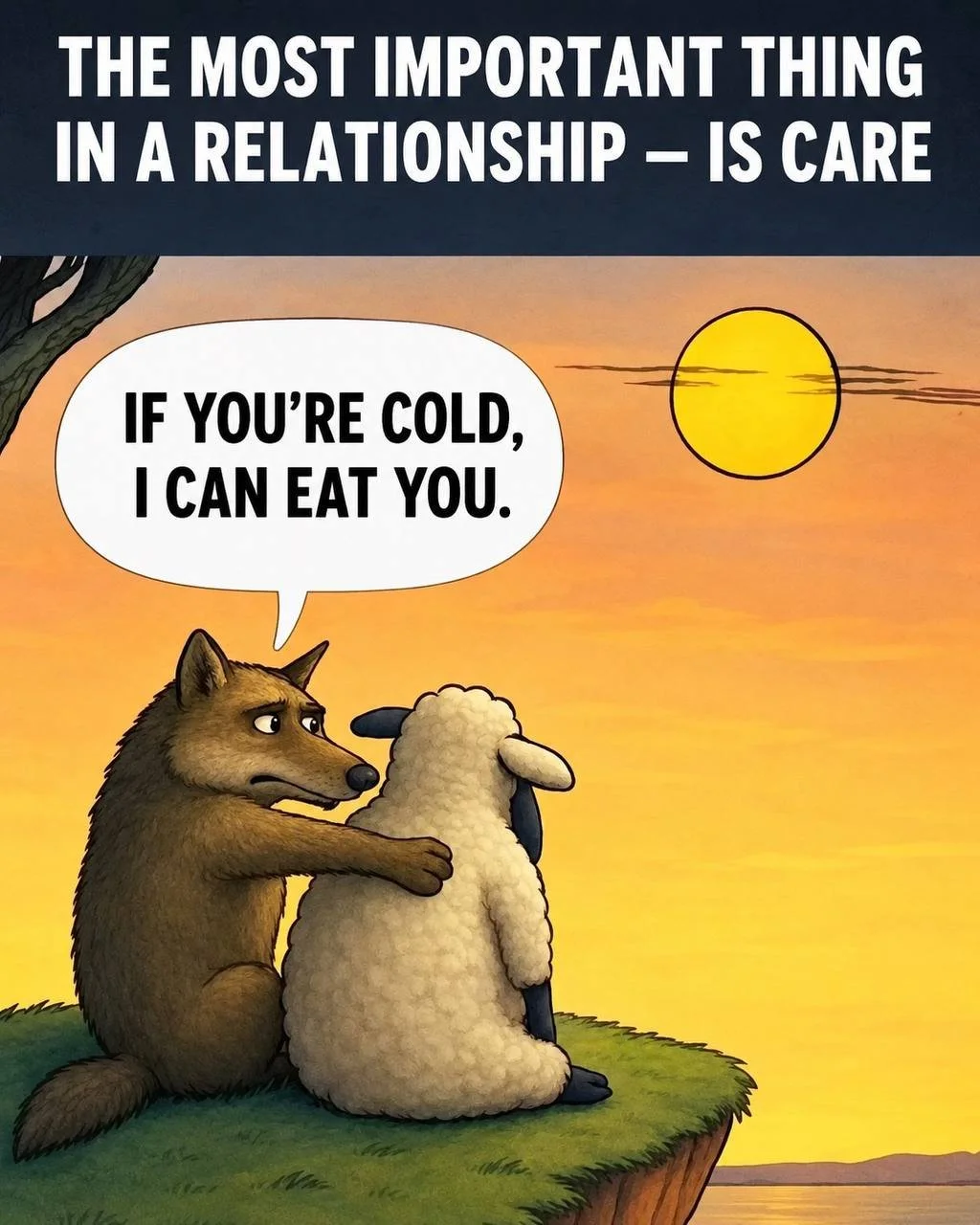
The wolf embraces the sheep so tenderly
that, from a distance, it almost resembles an icon.
Wool against wool. Breath against the nape.
A paw resting on the shoulder blade—heavy, warm,
almost motherly.
And only then does a sentence reach the human ear,
spoken in the gentlest voice of the pack:
“If you’re cold, I can eat you.”
And there you have it: the entire anthropology of “care”
that is sold to us as the highest form of love.
As above, so below.
As below, so above.
As on a global scale, so on an individual one.
Not “I’ll stay by your side while you’re cold.”
But “I am your only source of warmth,
and the way to it leads through my teeth.”
Care that doesn’t know how to step back,
not even a single pace,
quickly turns into digestion.
You are not being warmed so that you can get warm.
You are being warmed so that you will become softer…
Anthropology has long since learned
to look at this without romanticizing it.
There is love that holds you.
And there is love that devours you
and calls being swallowed intimacy.
The latter always arrives
with good intentions and a poor appetite.
“I’m only worried about you.”
“I only want what’s best for you.”
“You’ll perish without me.”
Translated from wolf language:
“Without me, you still exist as a separate being,
and that infuriates me.”
In such an embrace, the sheep makes
the classic mistake of its kind.
It confuses warmth with safety.
An embrace with an agreement.
Another’s hunger with its own need.
But another’s hunger is not about the sheep.
That hunger is about an emptiness
that is conveniently filled with someone else’s body
and then called destiny, family, nation,
“we are one whole.”
“We are one whole” is the favorite phrase of those
who see a partner’s or a citizen’s separateness
as an unwelcome draft.
Reality is even more merciless here.
Care without boundaries is power dressed in sheep’s clothing.
Not the kind of power that shouts into a microphone.
The kind that feeds you, tucks you in, decides for you
when you’re cold, when you’re hungry,
when you’re afraid—and gradually strips away
your right to endure the cold on your own.
The most sophisticated form of control doesn’t lock the door.
It makes you stop wanting to open it.
Outside, the wind is blowing.
Inside, there are jaws—but warm jaws.
The irony is that the wolf is often sincere.
It truly believes that devouring you
is a way of saving you.
That dissolving you into itself is the highest form
of “I’ll take care of you.”
A predator rarely sees itself as a predator
as long as its dinner agrees to call it love.
And the sheep rarely notices the teeth
until they touch its throat,
disguised by the words:
“I only wanted you to be warm.”
True care knows how to do something strange:
leave you whole and unharmed.
Give you a blanket without demanding your fleece
in return.
Warm you and let you go.
Say, “You’re cold,” without adding,
“and from now on, you belong to me.”
Everything else is not a relationship.
It’s agriculture with kisses.
An embrace you cannot leave alive
is not care.
It’s a menu on which you’ve already been listed
as the main course.
So tell me: are you being warmed,
or are you already being roasted?
From Illusion into the Light of Consciousness ♡
May Truth Prevail ♡
#Psychology #SelfDiscovery #PersonalGrowth #Healing #Relationships
