
When the Mask Falls: What Remains?
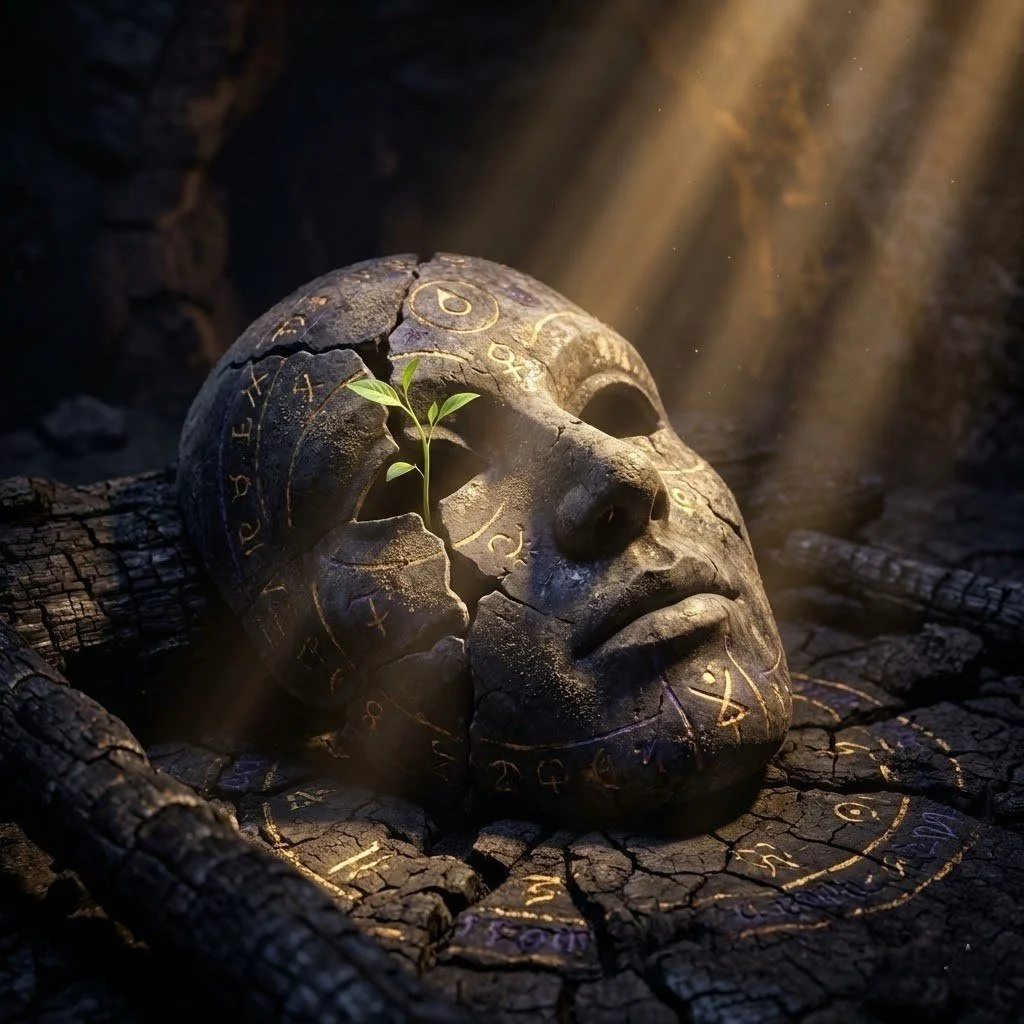
Integration means you can enter the role without becoming imprisoned by it. You can wear the mask consciously. And you can take it off consciously.
That is freedom.
When the Mask Becomes a Door
Perhaps the deepest paradox is this: The mask that conceals you can also reveal you.
Because what we repeatedly perform may point toward what we secretly desire.
The person who must always appear strong may be longing to be held.
The person who constantly gives may be longing to receive.
The person who disappears may be longing to be seen.
The person who controls everything may be longing to surrender.
The person who performs perfection may be protecting an enormous fear of being ordinary, or, perhaps, an even deeper fear: that they could be loved without earning it.
The mask leaves clues. It is a psychological map written in invisible ink.
And when we become curious enough to read it, we may discover that beneath the performance there is not emptiness.
There is life.
When the Mask Falls, What Remains?
Perhaps we imagine that healing means finally removing every mask and discovering one perfectly authentic self underneath.
But the human psyche is more mysterious than that.
We are not a single fixed face. We are a living constellation of memories, relationships, instincts, dreams, wounds, capacities, contradictions and possibilities.
We change. We grow. We integrate.
We become capable of holding opposites.
Strength and tenderness.
Solitude and intimacy.
Power and vulnerability.
Desire and restraint.
Grief and joy.
The goal is not to become someone who never wears a mask.
The goal is to know who is choosing to wear it.
To know when the protector is needed.
When the performer can rest.
When the child can speak.
When the Warrior can put down the sword.
When the Caregiver can receive.
When the Shadow can be witnessed without being allowed to take over the whole room.
And when the deepest self no longer needs to ask permission to exist.
Perhaps the question is not:
“What is my mask?”
Perhaps the more unsettling question is:
What if the thing you have spent your entire life calling a mask is actually a forgotten part of your true face?
What if your intensity is not something to erase, but something to understand?
What if your sensitivity is not weakness, but an intelligence that was never given a safe language?
What if your anger is carrying a boundary you were never allowed to have?
What if your longing is pointing toward a life you have postponed?
What if the identity you constructed to survive contains the raw material for the person you are now ready to become?
The mask may not be the opposite of truth.
It may be the path toward it.
And perhaps this is why ancient people understood something we have almost forgotten:
A mask is not merely something we put over the face.
It is something we pass through.
A threshold.
A ritual.
A mirror.
A doorway into the rooms of the psyche we have not yet dared to enter.
So perhaps we do not need to ask:
“How do I get rid of my mask?”
Perhaps we begin somewhere much gentler.
We ask:
“Who did this mask help me become?”
“What did it protect?”
“What did it cost me?”
And finally:
“Who might I become if I no longer had to confuse protection with identity?”
Because when the mask falls, it is not always the end of the story.
Sometimes it is the first moment you finally meet the face beneath it.
#Psychology #SelfDiscovery #PersonalGrowth #Healing
